Tuesday, February 14, 2012

New Science Unit Coming Up!

With the close of "Dinosaur Month," we are beginning a new unit focusing on...

drumroll please...


CONSTRUCTION!

If students are lucky, they may be seeing more  of this man. 
Students will explore the uses and purposes of small tools (hammers, nails, screws, screwdrivers, sandpaper) and large tools (dump trucks, bulldozers, backhoes). We will also explore some basic principles of space and architecture through various building exercises.

Some of the learning centers will be: 
- Building structures based on a pattern
- Using playdough and popsicle sticks to build small structures
- Hammering golf tees into styrofoam with small plastic hammers
- Exploring construction themes through library books

We can use your help! If you have styrofoam at your house that you've been dying to get rid of, we can use it. Please contact me if you do.

As always, thank you for being such wonderful and supportive parents. Let me know if you have any questions, comments, or ideas.

What happened to the dinosaurs?

As a fitting close to "Dinosaur Month," we talked about what happened to our dinosaur friends.

"Why did the dinosaurs die out?"

Students had varied--and creative--responses:
"Well, sometimes humans get old and die so maybe the dinosaurs got old and died." 
"They fell into volcanoes!"
"Some scientists say it was because of a lightning storm." 
"A meteor!"
... and my personal favorite, 
"They died because they were too big to fit in the Ark so Noah didn't bring them along." 


The truth of the matter is that no one really knows for sure how the dinosaurs died. Some scientists argue that massive volcano eruptions may have been the culprit as lava engulfed large areas of land and ash and gas filled the air. 

Others claim that a disease may have wiped out the dinosaurs or that the food-chain was permanently damaged by the death of certain key dinosaurs. Still others argue that the climate was gradually changing and that the colder temperatures were not suitable for cold-blooded dinosaurs. 

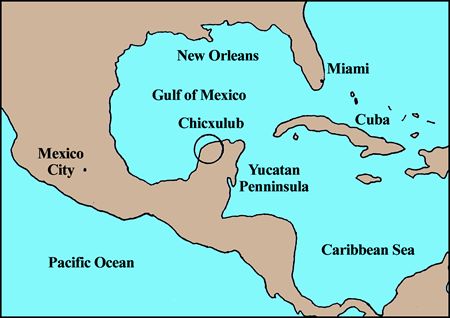
For a while now, the leading theory is that the dinosaurs died due to a meteor impact in Chicxulub (cheek-SHOE-lube), Mexico on the Yucatan Peninsula. 


Studies of Chicxulub show a possible impact site 110 miles in diameter. A meteor causing that much damage would have to have been at least 6 miles in diameter! Can you imagine? A flying rock that could extend from Parkside to Harvard Square? Scientists believe that enough ash and dust may have been sent into the earth's atmosphere to block out the sun for an extended period of time. Without the sun, plants died, and with them all herbivores (plant-eaters). Without herbivores, carnivores (meat-eaters) also met their demise. Only a smaller set of flying and swimming animals were able to survive. 

After talking to the students about this idea, I told them that no one really knows for sure how they died. One students quickly replied: "But God knows!"

That's right. God does know. And until we can ask him ourselves, we have the privilege of using the clues that the dinosaurs left behind to discover what we can!

Tuesday, January 31, 2012

Carnivore or Herbivore?

This week's lesson began with a review of our three main points from last week:
1. Dinosaurs died a long time before anyone could see them. 
2. The way scientists learn about dinosaurs is by studying the bones they left behind, called fossils
3. Scientists who study dinosaurs are called paleontologists

Now, for the new stuff: 

Scientists put dinosaurs in two groups based on what they mainly ate. Carnivores were dinosaurs that mostly ate meat; herbivores were dinosaurs that mostly ate plants. 

There are two ways of knowing whether a dinosaur was a carnivore or herbivore: 
Triceratops - four-legged herbivore
1. Look at the legs. Dinosaurs who walked on four legs tended to be herbivores, while dinosaurs that walked on two legs tended to be carnivores. 
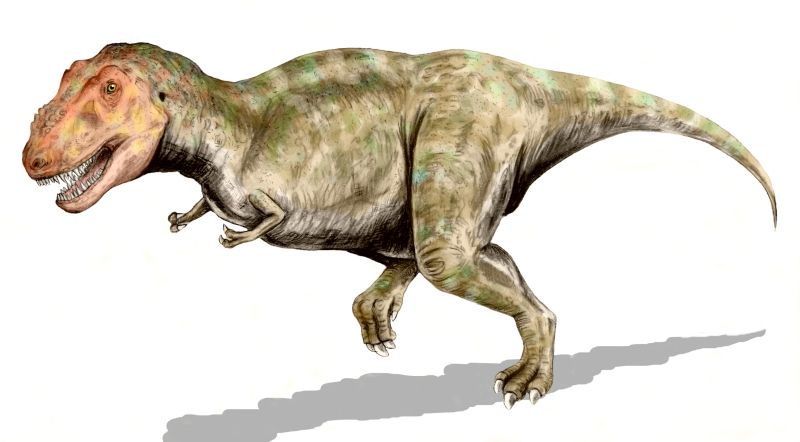
Tyrannosaurus Rex - two-legged carnivore

Parasaurolophus - two-legged herbivore
2. Look at the teeth. Dinosaurs with sharp, pointy teeth tended to be carnivores. Dinosaurs with flat teeth, similar to our molars, tended to be herbivores. 
Carnivore or herbivore?

Questions for you and your child:
1. How many carnivores can you name out of dinosaurs and animals that are alive today? How many herbivores
2. How do you know whether a dinosaur is a carnivore or an herbivore
3. Using the teeth in your mouth, show me which kind of teeth are for ripping at meat and which kind are for chewing plants.

Be sure to check out the "All Aboard" game on the Dinosaur Train Game Site for your student to get some more practice differentiating between carnivores and herbivores.

Tuesday, January 17, 2012

Dinosaur Month Week 2--Questions for you and your student

A paleontologist working at a dig-site to uncover a Spinophorosaurus fossil!

Students continue to acquaint themselves with our learning stations as we talk this week about FOSSILS.

Below are questions that you can be asking your student to reinforce the concepts he/she is learning in class. Be sure to visit Dinosaur Train for fun dinosaur activities, games, and videos as well!

1. Were dinosaurs around when people were around? No. Dinosaurs lived millions of years ago before humans were around. No human has ever seen a dinosaur!

2. If dinosaurs were not around when people were around, how do scientists learn about them? Scientists study fossils to learn about dinosaurs, their surroundings, and their lifestyles. 

3. What are fossils? Fossils are the remains of plants and animals that have turned into a special kind of rock.
Most fossils are made of plants and sea-life. Dinosaur fossils are rare!

4. What do we call a scientist who studies fossils? A paleontologist (pay-lee-un-taw-lo-jist).

EXTRA CREDIT: 

5. Are most fossils made of dinosaur bones? No, most fossils are actually composed of sea life. Dinosaur bones are very rare! 

6. If dinosaurs lived all over the earth, why don't we find more fossils than we do? Fossilization is a very unique process. If a dinosaur's bones aren't buried in the right kind of material with the right kind of conditions (pressure, moisture level, temperature, et. al.), fossilization will not occur. Only a small percentage of dinosaur bones made it through the fossilization process without rotting away. For more information, go to http://www.enchantedlearning.com/subjects/dinosaurs/dinofossils/Fossilhow.html

Tuesday, January 10, 2012

Dinosaur Learning Centers Underway

Our students are acquainting themselves with their learning centers. Below you can see pictures from the action!

Dino-Dig
All photos by William Chester, not for public use without permission.

Dinosaur Free Play


Dinosaur Train

Dinosaur Reads

Dino Draw

Monday, January 9, 2012

Dinosaur Month Begins!

Discovery Science will be focusing on Dinosaurs for the next month and we've gotten off to a great start!


New to this unit is a station system in which students will rotate to various learning centers throughout the instruction time. In later weeks we will focus on specific learning objectives in addition to the learning centers, but for now we're just getting used to exploring each center. Below is a peak at some of the centers--pictures to come!


-       Dino Dig – students use brushes that paleontologists use to uncover prehistoric fossils

-       How big was the Brachiosaurus? – The Brachiosaurus was one of the tallest dinosaurs. In this activity, students compare the height of boys and girls, giraffes, and the Tyrannosaurus Rex by velcroing handouts of each to a poster that shows the relative size of the Brachiosaurus.

-       Dinosaur Reads – Students read and look at exciting pictures of dinosaurs from books collected at the Boston Public Library. 

-       Dinosaur Free Play – I grew up loving dinosaurs and I brought my collection of rubber dinosaurs for students to play with. Students learn about the features of various dinosaurs as they enjoy free play time. 

-       Dinosaur Train – Dinosaur Train is a popular educational show on PBS. This station allows students to listen quietly to an episode.

-       Dino Draw – Students learn about the features of dinosaurs as they draw and color using these coloring sheets from Dinosaur Train on PBS.